Wednesday, April 29, 2009

We All Live in a Jell-O Submarine


Throughout the first eight months, each of us have had our struggles. Missing friends and community. Advancing our language skills. Changing our diets to reflect the economics, scarcities and abundance of local food. Learning to live with uncertainty and realizing that advanced planning is a preference and a privilege.


One of us, however, has approximated “going native,” or at least becoming bicultural in her bones. Last week at breakfast, Risa had a request for us. For her snack at school, could we please stop sending peanut butter cracker and carrots? Instead, she would prefer an arepa with cheese. Wrapped in tinfoil. In the shape of a heart. Each morning, she and her friends at school eat their merienda, morning snack, together. She would like to be like them. Unlike the rest of our family, who instinctively grab the arepa like a burger, Risa looks around for a napkin to eat the food the same way everyone else in this country would. However, she holds tight to her vegetarianism despite her friends adding all kinds of meat to fill their arepas.


Spanish has six different ways of conjugating verbs. Victor has mastered the patterns, but choosing among the three past tenses is a challenge. Anson has learned to conjugate present and preterit with study and practice. Their progress this year is impressive, and Victor recently noticed that folks he found difficult to understand early in our year now sound comprehendible to him. After twenty years of speaking Spanish, I feel fairly comfortable but make occasional errors. Then, we have our truly bilingual daughter. Risa feels the conjugations intuitively, with only a few mistakes that mimic not an English speaker, but a young child raised in Spanish.


The months in Venezuela with my family gives a new way of experiencing this society, quite distinct from my previous years here as a younger person. I see how the kids’ classrooms and sports teams value both conformity and community, with a tight-knit affection among students. I have spent a lot of time discussing with Risa why she is the only girl on her gymnastics team who doesn’t have pierced ears. After living here a year, it doesn’t make much sense to force her to wait until age ten, and she will get earrings in the fall for her seventh birthday. After years in Latin America among beggars in public places, Anson has engaged me in difficult conversations about why this happens, and how begging is tied to personal circumstance, cultural practices, national policy, and global inequalities.


Risa’s classroom has an English class in which the teacher, a college student, teaches them Beatles tunes. My daughter loves the class because she gets to master songs that she had heard before. To my amusement, she has learned them with the ear of a native Spanish speaker, belting out at the top of her lungs the songs in her classmate’s accent. Why the heck wouldn’t we live in a Jell-O Submarine? Yum!

Thursday, February 12, 2009

Merida and Sunday's Elections: A Brief Report

This weekend, Venezuelans will vote yes or no on a constitutional amendment to end term limits for all government officials. The measure will almost surely pass, probably with support in the low fifty percentage points. Despite U.S. press rhetoric, and serious flaws in President Chávez’s governance, the president is popular and supported by the majority. The referendum will put an end to weeks of intensive street rallies, some marred by violence, but mostly peaceful by both sides.

Our town of Mérida has seen both peaceful and violent manifestations of peoples’ feelings about the enmienda. In the past three weeks, demonstrations and riots at the University of the Andes (ULA) have accelerated. I plan to photograph a “no” march organized by students this afternoon at 4pm (Thursday 2/12) The occurrences of violence against demonstrators at universities throughout the nation have escalated as students, originating mostly but not exclusively from Venezuela’s small middle-class, play an increasingly central role in opposing the amendment proposal. The last Tuesday in January, reports of student injury from clashes with police emerged from three campuses throughout the country.

Beginning in early December, President Chávez began a public process to amend the constitution in order to abolish term limits. Citizens will vote on the measure on February 15, which will be the third election cycle in fourteen months. The campaign hit full stride in the late January, with a commiserate shift in tone and activity on campus. Several times a week students organize forums on campus and in five days, students have covered the town in graffiti supporting both Sí and No positions. The ULA official website is filled with opposition to the proposal, and administrators left their offices January 27 to join the “March for No”. Within one hundred yards of each other, upbeat students proclaiming Sí and No publicly campaign several times a week without interaction as police watch at either end of the street.

The recent events at ULA enflamed further when armed pro-Chávez demonstrators, according to news accounts, arrived at the demonstration. At the entrance to ULA’s largest of three local campuses, young men protesting Chávez wore ski masks and t-shirts to hide their identity. As they burned tires in the street and threw rocks, the police stood watch with rifles and bullet-proof vests. When tear gas wafted into the Social Science and Economic Cafeteria, students calmly walked out to stop the burning sensations in their eyes and nose. It took me a minute to realize that I was breathing tear gas, feeling much more panicked than the matter of factness reflected on the faces of those around me.

The police lanced the tear gas towards group of student organizers protesting the proposed constitutional amendment and the alleged vandalism of student government offices by a pro-Chávez organization. Reports from eyewitnesses, newspapers and websites offer highly conflicted reports of the sequence of events and responsible parties, depending on the source’s allegiance to Chávez or the opposition.

Located 425 miles southwest of Caracas in the country’s only primarily university town, Merida’s ULA has frequent strikes and street disturbances. Typically, the actions involve grievances over university autonomy and student conditions. It is a rare student who graduates in the five year normative time, thanks to days and even weeks of suspended classes due to actions ranging from highly coordinated public protest to street closures by small groups of masked encapuchados. The scene of hooded young men throwing rocks and burning tires occurs at least once a month in front of one of ULA’s campuses. Police have no authority on campus grounds due to strict constitutional law mandating university autonomy. This includes the street in front of ULA, giving even a small number of students the ability to close the main artery of the city during peak hours.

The campaign for the amendment reflects a decade of struggle in which each side publicly claims to be pacifist. Meanwhile both positions dismiss and berate the opponent. Pro-amendment literature describes university student opposition as “bourgeoisie university students,” lumped in with social sectors labeled “the squalid”, the anti-Venezuelan, and the devil. Opponents dismiss Chávez supporters as irrational and “bought,” labeling a victory in the amendment proposal “indefinite destruction for Venezuela”, leaving neither side with much room for considered discussion. Although polls vary, the amendment appears to have slight majority favor among Venezuela’s nearly seventeen million voters.

Tuesday’s demonstrations included a series of unusual events that indicated the escalation of tensions in light of the upcoming constitutional election. A motorcycle group of armed Chávez supporters arrived and the Venezuelan National Guard sent tanks to the main avenue, although accounts vary as to who gave orders for the action. The tanks’ presence echoed Chavez’s pronouncement that students who blocked the streets would be “swallowing some of that good kind of gas.” He added late last week that university administrators were behind the recent protest, “using the kids” and “poisoning the youth.” Nonetheless, he called the students “embarrassing and pitiable,” products of what he calls the poor training in their universities.

Chávez supporters and opponents continue to clash, occasionally in the streets but more often on their separate television channels and within families. As I interview young adults for a book project on how their generation constructs political and economic subjectivities, adherents to both sides articulate more careful analysis of their opponents than the public rhetoric suggests. University students in Mérida express a desire for an alternative, not necessarily to Chávez, but to the civil society impasse in which the university is embroiled. Opositores describe positive aspects of what supporters call the Bolivarian Revolution, including policies to help the poor, a return of sovereignty, and national cultural promotion. Adherents admit a weariness with repeated elections, crime, and heated rhetoric, complaints often voiced by their opponents. Venezuelan public discourse, however, continues at a standoff, making it difficult to imagine student de-escalation with either President Chávez in office or an oppositional victory.

Thursday, January 22, 2009

Happy New Year!

I have always loved the idea of the New Year’s Bash. I imagine the “When Harry Met Sally” version: Champaign, fancy clothes, great music, and a balloon drop at midnight. Sounds delightful. Never done it. My tribe doesn’t do big parties, really. There is no line in my budget for formalwear. And I don’t recall any kids around when Harry kissed Sally. A U.S. New Year’s party is decidedly age segregated. While some Americans ring out the old in this way, many of us greet the New Year drooling on our pillow.


Venezuelans consider New Year’s a central holiday. It is as important as Christmas, if not more so. When I tell them that my family will not be together on this night, and some will not be awake to even recognize the changing year, they give me looks of pity and surprise. Venezuelan New Year’s Eve is a family affair, and it involves dressing up. Generations spend the evening together, sharing good food, music, and, among adults, alcohol.


One of my most vivid and fond memories of my exchange student year in Maracaibo was a night of Champaign, dress-up and celebration on December 31, 1987. So much did I want to relive this event with my family that I planned our winter vacation dates around arriving in Maracaibo for “The 31st,” as the holiday is called. After a tearful goodbye to my in-laws and recovery from the eight hour drive (at 30 miles an hour – a topic for another time), I began my anticipation of the evening.


I prepare the kids for a late night beyond their wildest dreams. Most U.S. parents treat bedtime the way the NFL treats the football schedule. Perhaps a major terrorist attack might create a delay, but not much else. I have hosted and attended many U.S. parties where parents depart because they do not want to violate the sacred bedtime hour. Venezuelans do not let some calcified schedule interrupt a gathering. Once again proving that culture often trumps biology, this does not seem to phase kids a bit here. My Venezuelan niece does not take a nap to prepare for the late night, nor does her family worry about or even mention that she would be “up past her bedtime.” My gringo daughter has not had a lifetime of late-night family gatherings, so we nap in preparation.


Around 7:30 pm, we lose half of our revelers when Anson fell sick with a sudden flu. He and Victor spend the evening at my host sister’s apartment with Direct TV. Disappointed but anticipating the evening, Risa and I dress in our best and head out.


As Venezuelans spend the evening with family, couples negotiate

how to split the evening, using techniques deployed by partners in U.S. Christmas. My host sister’s husband spends the first part of the evening with his wife, then leaves with his father to arrive in time for ringing in the year with siblings and mother. My brother and his wife for the past twenty years have spent the evening with their mothers, with their children following the pattern. Tio Nerio has been the annual host for my maracucho family’s New Year’s Eve for over two decades. A business owner living in a spacious home with ample help to cater the party, he hosts with Champaign and gracious rooms to spread and spend the evening. For several hours, Risa plays with her cousin Cami while I pinch myself, unable to believe that I have returned to this family after twenty years, and that they have welcomed me back with such grace and affection. We talk, drink Champaign, and take pictures.


Close to midnight, the grapes arrive at the table. Each guest tries to eat twelve in the last minutes of the year, making a wish for each. Risa and I work on our grapes together. Her wishes: a horse and “horse equipment.” My wishes: health, a book manuscript, continued family joy. My host mother, who loves Barack Obama as passionately as I do, wishes along with me for his success as president. Our wishes made, we begin waiting. We count down to midnight. Risa and I give the first hug of the New Year, followed by hugs and kisses for EVERY person of the twenty-some guests who spent the evening toegehter.


We rush to the street to watch the fireworks being shot out across the neighborhood. “There is some major money being shot out here,” comments more than one guest. The girls look giddy (see left) as across the entire horizon, in the dark of Venezuela’s second largest city, fireworks explode. The delight on Risa’s face as she hugs her cousin and watches is the moment I will remember always from this night.


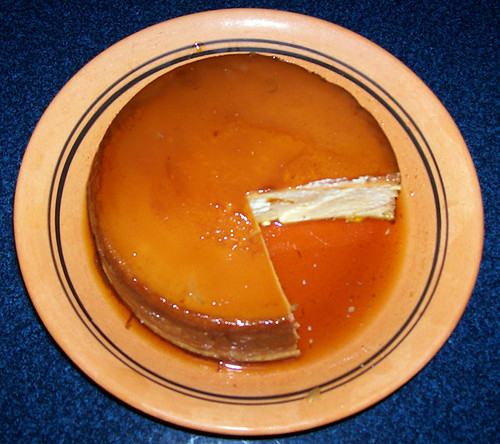
After the business of welcoming in 2009, it is time to eat. Women from the family have brought the must-serve Venezuelan holiday dishes, including hallacas, turkey, pork, Russian salad, and a version of lasagna. Tio Nerio’s cook and house manager of twenty-eight years also provides fantastic food. To top things off, my host sisters own a high-end, by-commission-only bakery, Delicious…, so my sister also bring one of the country's most traditional dishes, quesillo, and a fabulous lemon pie. The girls have already eaten, and move straight to dessert. Other guests arrive. We take turns at the table enjoying this bounty. It almost replaced the Thanksgiving we missed this year. The only thing missing were my two guys, stuck at home thanks to the flu.


My family considers their New Year’s party to have an early ending. “By 1:30, we’re done. It’s time for bed,” my mother tells me over and over. No problem for the gringos! I remember concerts and dances lasting all night when I lived with them in the 80s. Other friends in our hometown Merida reported festivities lasting until three or four.


At the end of the meal, the party is over. We say goodnight to each person with a kiss, and walk into the sultry night, just Risa, my host Mom, and me. Risa chatters in Spanish about the night, the food, and how tired she is. She clearly feels proud of her ability to stay up so late! I carry her to bed and tuck her in around three. Despite no balloon drop, it was a magical evening for us both.